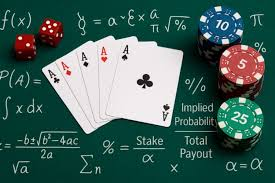
The Mathematics of Casino Games: How Probability Theory Powers Modern Gambling
We often think of casinos as temples of chance, but behind every spin, deal, and roll lies a universe of cold, hard mathematics. The flashing lights and ringing slots are merely a spectacle draped over a framework built entirely from probability theory and statistical models. From the historic roulette tables of London’s Hippodrome Casino to the digital blackjack games regulated by the UK Gambling Commission, every aspect of the gambling industry is engineered by mathematical principles that guarantee its long-term viability. Understanding this hidden architecture not only demystifies the games but also connects to broader fields of research, from the statistical models used in UK climate science to the foundational probability research that shapes Canadian climate research.
The Core Principles: Probability Theory in a Casino Setting
At its heart, a casino is a financial institution that prices risk. The games are carefully calibrated financial products where the odds are mathematically tilted in the house’s favour. This isn’t based on luck or superstition; it’s the inevitable result of applying centuries-old probability theory, with foundational work by mathematicians like Blaise Pascal and Pierre-Simon Laplace providing the bedrock. Three key concepts form the trinity of casino mathematics: expected value, house edge, and variance.
Expected Value: The Unseen Guarantee
Expected Value (EV) is the cornerstone. It represents the average amount a player can expect to win or lose per bet if that bet were repeated millions of times. For any casino game, the EV for the player is negative, while the EV for the house is positive. This long-term average is not a guess; it’s a mathematical certainty derived from the game’s rules and probabilities. It’s the reason a casino can be confident of profit over time, regardless of short-term wins for individual players.
House Edge: The Built-In Advantage
The house edge is the mathematical expression of the casino’s profit margin, typically presented as a percentage of each wager. It is the inverse of the player’s EV. For example, in European roulette with a single zero, the house edge is calculated to be approximately 2.7%. This means that for every £100 wagered, the casino expects to retain £2.70 in profit over the long run. Different games have different edges, which is a primary factor in their design and popularity.
Variance: The Spice of the Game
Variance is what allows the illusion of beating the system to persist. It measures the statistical dispersion of results around the expected value. A high-variance game, like a progressive slot machine, can produce infrequent but massive payouts amidst long losing streaks. A low-variance game, like blackjack played with basic strategy, sees results cluster closer to the expected loss rate. Variance creates the thrilling short-term unpredictability that keeps players engaged, while the house edge quietly ensures the casino’s bottom line.
Statistical Models in Action: From Roulette to Blackjack
Applying these principles to specific games reveals the elegant, and sometimes complex, statistical models at play. The UK Gambling Commission’s data consistently shows roulette and blackjack among the most popular table games, each offering a distinct lesson in probability.
Roulette: A Study in Independent Trials
Roulette is a perfect model of independent trials. Each spin is a fresh event with no memory of previous outcomes. The probability of the ball landing on any single number on a European wheel is always 1 in 37 (or 1 in 38 for American wheels). This constancy allows for straightforward calculation of odds and the house edge. The gambler’s fallacy—the belief that a ‘due’ number will hit—is a direct misunderstanding of this independence, a cognitive error probability theory clearly debunks.
Blackjack: Dependent Events and Basic Strategy
Blackjack introduces dependent events, as each card dealt changes the composition of the remaining deck. This dependency is what makes card counting theoretically possible. The game’s statistical model is more complex than roulette’s. By using probability theory, mathematicians have derived a “basic strategy”—a set of optimal decisions for every possible player hand against the dealer’s up-card. Adhering to this strategy minimises the house edge to often less than 1%, making it one of the best odds in the casino, though still negative for the player.
Randomness and Regulation: The Role of UK Gaming Authorities
For the mathematical models to be legitimate, the games must be truly random. This is where regulation becomes crucial. The UK Gambling Commission mandates strict technical standards to ensure the integrity of games, both online and in physical venues.
Certifying Random Number Generators (RNGs)
For online casinos, fairness hinges on the use of certified Random Number Generators (RNGs). These are sophisticated algorithms that produce unpredictable, non-sequential results for digital slots, card shuffling, and roulette spins. The UKGC requires that these RNGs be independently tested and certified by approved third-party agencies to ensure they are truly random and not biased toward the operator. This certification is a non-negotiable requirement for obtaining a UK licence.
Auditing Tables and Machines
In brick-and-mortar establishments like London’s Hippodrome Casino, regulation extends to physical audits. Independent testing labs inspect roulette wheels for mechanical bias and analyse the physical properties of playing cards and dice. Slot machines are subjected to similar scrutiny to verify their published return-to-player (RTP) percentages, which are directly derived from their probability settings. This regulatory framework enforces the mathematical contract between the casino and the player.
Probability Research Beyond the Casino Floor
The mathematics of gambling is not an isolated field. Its concepts and tools have profoundly influenced other scientific disciplines, creating a fascinating bridge between the casino and the laboratory.
The Monte Carlo Method: From Las Vegas to Climate Science
The most famous crossover is the Monte Carlo method. Developed during the Manhattan Project and named after the Monaco casino hub, this computational algorithm uses repeated random sampling to model the probability of complex outcomes. Crucially, it is now a bedrock tool in climate modelling. Scientists use the Monte Carlo method in climate science to run thousands of simulations with varying initial conditions, helping to quantify uncertainty in forecasts for both UK climate science and Canadian climate research projects. It turns the principle of simulating millions of spins to find an average into a way of predicting global temperature pathways.
Gambler’s Fallacy in Everyday Decision Making
Research into cognitive biases like the gambler’s fallacy extends into behavioural economics and psychology. The mistaken belief that past independent events influence future ones affects decisions in finance, business, and even everyday life. Understanding this fallacy, rooted in casino probability, helps in developing better statistical literacy and more rational decision-making frameworks.
Why Understanding the Math Matters for Players
For the casual visitor or the serious enthusiast, grasping the underlying mathematics is the first step toward informed and responsible participation. It dispels myths and sets realistic expectations.
Identifying Long-Term Odds
A clear understanding of EV and house edge allows a player to see past the marketing and recognise which games offer the best (or least poor) odds. For instance, knowing the difference between the 2.7% edge on European roulette versus the 5.26% on the American double-zero wheel is powerful, actionable information. It enables a player to make a conscious choice about the price of their entertainment.
The Myth of ‘Beating the System’
Mathematics definitively shows that for the vast majority of players, beating the casino in the long term is impossible. Systems like the Martingale in roulette (doubling your bet after a loss) crumble under the realities of table limits, finite bankrolls, and the unwavering house edge. Recognising this counters dangerous illusions and promotes a healthier, entertainment-first mindset. The key takeaways for a mathematically-informed player are:
- The house edge is a permanent, unbeatable fee for play.
- Variance explains short-term wins and losses, not skill or “luck.”
- Games like blackjack have a skill component that can minimise loss, not create profit.
- All systems fail in the face of negative expected value.
In conclusion, the world of gambling is a meticulously designed mathematical ecosystem. From the certified RNG in an online game to the audited wheel in a grand casino, every element is governed by the immutable laws of probability and statistics. While this framework guarantees the industry’s profitability, it also offers players a powerful lens through which to view the games. Understanding that the true opponent is not luck, but a calculated edge, is the ultimate key to a realistic and responsible approach. This same mathematics, as seen in tools like the Monte Carlo method, proves that the concepts governing the roll of a die can also help model the future of our planet.






Post Comment
You must be logged in to post a comment.